Showing posts with label Foreign Policy. Show all posts

Saturday, October 10, 2009

Obama and Nobel: Absurdity on Parade

Sometimes life's absurdities become so blatant, so consuming, that one cannot hellp but question the sanity of the world we live in. One cannot sanely sympathize with poor white people that protest against a lone black man because they envision some sort of holocaust against their meager existence while in fact this same man is tirelessly working to promote the fortune and power of the same white, Protestant men who've always held the same. How does one begin to argue with a man or woman who has been convinced to fight, sometimes violently, to promote someone else's interests to the detriment of their own?

How does one begin to argue with a nation of immigrants who believe to the core of their souls that this wave of immigrants are not lured by higher pay than they can find in their own country (thanks in part to US policies) but rather by a genocidal desire to murder their children? How does one convince a man like Rush Limbaugh or his drones that teenagers fight over stupid things like seats on a bus and that such an occurrence is not an indicator of a large-scale conspiracy on the part of all black people to exterminate the white race, as if whites were somehow on the precipice of extinction?

How, then, are we to respond to the news that a man responsible for widespread death in three countries, bellicose threats to another, and demonstrable loyalty to the position that you're either with the United States or you're dead receiving a prize for the propagation of Peace?

The President:

Let me be clear: I do not view it as a recognition of my own accomplishments, but rather as an affirmation of American leadership on behalf of aspirations held by people in all nations.

Presumably, "all nations" is typical US code for those nations that agree with our foreign policy. One cannot believe that every Afghani who's had his home destroyed by American soldiers or paid mercenaries cheers "American leadership" as he watches the smoldering rubble of his former life.

The Orwellian construct, "War is Peace," is prescient here. Obama has yet to deviate from the neoconservative delusion that the only way to bring peace through the world is through endless war. Here, there is no alternative to the Bush worldview; a worldview which allows a man to stand above the fray, safely removed from danger, look over the smoldering of several countries and pride themselves on how much peace their weapons have wrought.

Part of the explanation of the prize was also Obama's supposed commitment to ridding the world of nuclear weapons. Of course, nowhere in that idealistic endeavor is the world's largest stockpile of nuclear weapons mentioned. That would just be insane. Ignorance is Knowledge.

All this lends credence to what C Wright Mills called "crackpot realism."

From the essay "On Knowledge and Power:"

It is not the barbarous irrationality of uncouth, dour Senators that is the American danger; it is the respected judgments of Secretaries of State, the earnest platitudes of Presidents...that is the main danger. For these men have replaced mind by the platitude, and the dogmas by which they are legitimated are so widely accepted that no counter-balance of mind prevails against them. Such men as these are crackpot realists, who, in the name of realism have constructed a paranoid reality all their own and in the name of practicality have projected a utopian image...

Or from The Causes of World War Three:

In crackpot realism, a high-flying moral rhetoric is joined with an opportunist crawling among a great scatter of unfocused fears and demands. In fact, the main content of “politics” is now a struggle among men equally expert in practical next steps—which, in summary, make up the thrust toward war—and in great, round, hortatory principles. (p. 86)

. . . The expectation of war solves many problems of the crackpot realists; it also confronts them with many new problems. Yet these, the problems of war, often seem easier to handle. They are out in the open: to produce more, to plan how to kill more of the enemy, to move materials thousands of miles. . . . So instead of the unknown fear, the anxiety without end, some men of the higher circles prefer the simplification of known catastrophe. (p. 87)

. . . They know of no solutions to the paradoxes of the Middle East and Europe, the Far East and Africa except the landing of Marines. Being baffled, and also being very tired of being baffled, they have come to believe that there is no way out—except war—which would remove all the bewildering paradoxes of their tedious and now misguided attempts to construct peace. In place of these paradoxes they prefer the bright, clear problems of war—as they used to be. For they still believe that “winning” means something, although they never tell us what. (p. 88)

. . . Some men want war for sordid, others for idealistic, reasons; some for personal gain, others for impersonal principle. But most of those who consciously want war and accept it, and so help to create its “inevitability,” want it in order to shift the locus of their problems. (p. 88)

So, these politicians create their own reality, again in the Orwellian fashion, in which all anxieties, all uncertainties, are eliminated. From whole cloth, they create a world where victory and defeat fall along clearly-defined lines (though they are never able to express those lines to the public). In their world, enemies and friends are clearly defined, and the status of good and evil coincide perfectly. Circular logic dictates that friends are good, enemies are evil. That one defines the other does not seem to trouble their minds, from which they have systematically removed all seeds of doubt or attempts at objective definition.

Having created this reality, these politicians then foist it upon the world. This fabricated worldview becomes truth, rather than the reverse, and the world must subscribe to the reality as the politicians fight vociferously to defend their creation.

Once created, this worldview cannot be questioned. All positions must then flow forth from it. One must begin with the assumption that bombing villages breeds peace. One must subscribe to the notion that the countries with the largest nuclear arsenals are the natural leaders in the cause of reducing such arsenals (in those countries that don't have them). One must accept without question that no matter how poorly a war has been waged for nearly a decade, success (indefinable though it is) is just around the corner, if only a few thousand more soldiers can be brought ashore.

The most important feature of crackpot realism then, is the inability of observers to engage in any discussion which does not begin with the assumption of all that the crackpots have constructed. All discussion of foreign policy must begin with their fabricated premises, which ensures that such a debate cannot possibly progress. Much of the country, and apparently the world, fails to see this.

As long as discussion is constrained to the limits that the rulers set, "peace" is a fantasy. Indeed, mere mention of the word presents the speaker to the word as a wild-eyed naif unfit for public consumption. There is no reason for this to be. There is no reason that discussion should be constrained by bounds set by those who stand to profit most from its limitation. There is no reason that awards for peace should be awarded to a man who's only qualifications seem to be that he is the most eloquent of the ambassadors for the world of the crackpot realists.

When debate is artificially constrained, it ceases to be debate at all. It has become absolution of a vile worldview.

Sphere: Related Content

Wednesday, October 7, 2009

Congress Demonstrates its Fiscal Skepticism


Er, title changed to reflect the fact that I'm not an idiot re: possessive v. contraction

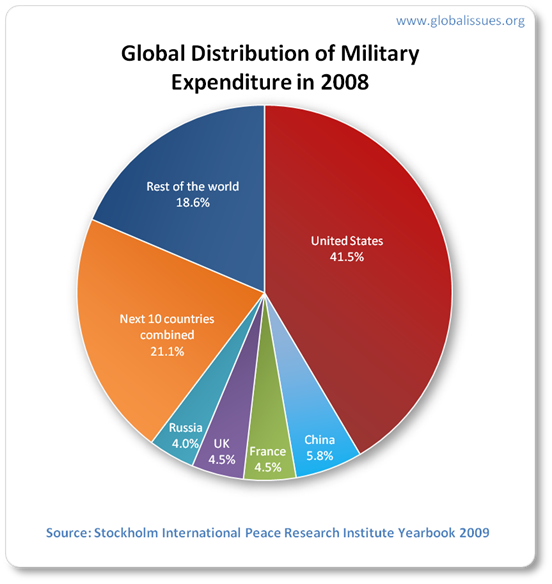
So, that crusader for peace and hope, Barack Obama, has once again demonstrated his commitment to prolonging the Bush presidency. On Tuesday, the Senate approved his first defense budget, with the stated price tag of $626 billion, the largest ever. That's greater than the GDP of all but 17 countries using the IMF numbers from 2008. And again, this was significantly higher than the largest budget requested by Bush, putting perhaps the final nail in the coffin of the fantastical belief that Obama will lead the country down a different path in foreign policy.

I say "stated" because history shows that the Defense Department is never held to the number. If the budget runs over, so be it. Also, as Tom Engelhardt notes, "various military expenses like the upkeep of our nuclear arsenal aren't even in that budget."

The budget itself is no surprise, as any suggestions that the US will ever pare down its military expenditures are grounds for forced commitment and life in a padded cell. The grating part is that for months Republicans and Democrats alike have been parading around feigning fiscal responsibility in the health care debate, rushing to declare that $850 billion over 10 years signifies the height of recklessness. Yet here we see the Senate pass a bill 93-7 which promises to exceed that in less than a year and half. Bipartisanism is alive and well, indeed.

But it’s more than simply the obvious lack of logical continuity and mathematical literacy here. It’s the laughable claim that these Congressmen oppose any sort of health care reform on the grounds that it would put the government into a controlling position over the free market. But consider where this money goes. It is nothing but a vast diversion of public money (presumably the same money the tea-baggers would like back) to private companies.

The money will go, as always, to the same companies lusting for the free market in no-bid, cost-plus contracts. It will go toward creating artificial overseas markets for those same companies. It will provide those companies with a consumer (us) with no arena for recourse, no ability to express displeasure with capital flight; Or, not one indicator of the free market these businesses and their compatriots in Congress claim their un-dying affection for. Artificial markets. No free choice on the part of the consumer. Nothing which would signify free market principles.

Of course, the claim will be made that “defense” is not something to be debated. Unlike health care, “defense” is not an arena where these vermin who vacillate over every last dollar of a health care bill can enter with similar skepticism. The President says “I want this much (for now),” and Congress says, “How fast can I funnel that to you?”

And of course, using the money as the United States is wont to do will always create a higher demand for the next year’s budget. We need the money for defense because people hate us, we use the money to exacerbate those feelings, therefore we will need more next year to combat the bile we’re milked from the world in this one. All the while, we pretend that Afghanis and Iraqis will forget that they are without electricity, food, or basic security from bodily harm. They will forget the death squads, forget the corrupt governments, forget the Predator raids on weddings. They will forget, and then they’ll love us and our freedoms.

Until then, dying Americans will just have to wait while Congress spends as much in less than 18 months—without batting an eye—as they refuse to consider spending over the course of a decade for their own citizens.


Related Posts:

Mental Recession or Just Mental? July 15, 2008
Surge II: Afghanistan July 15, 2008

Sphere: Related Content

Monday, October 5, 2009

When I Go Forwards You Go Backwards...And Somewhere We Will Meet.

Title lyrics from Radiohead's "Electioneering."

Last week, I lamented the inattention to the Afghan election held on August 20th. It's not just the widespread fraud that infuriates, but the blatant disregard for it in the country that is supposed to be pushing democracy there. The silence of benefactors goes a lot further in illustrating to Afghanis where they stand than all the propaganda leaflets in the world. (Indeed, one Afghan girl was recently killed by such a drop from a British plane.)

But the issue here is more than simply inattention, it's a dedicated effort on the part of those charged with ensuring a fair vote to protect the exact opposite outcome. In an op-ed in the Washington Post and in an interview with Amy Goodman, the fired UN official Peter Galbraith indicated that the dispute that led to his recall was "not over how to handle electoral fraud, but over whether the UN should handle it." In other words, though it is clear to all that fraud occurred (Karzai has admitted as much), the UN and the Electoral Complaints Commission has tried to take a stance of non-interference. Such a stance would seem to call into question their very existence, but they don't seem troubled by such logic.

Galbraith:

First, in advance of the election, he [Kai Eide, head of the Afghan mission]—when I was trying to reduce the number of the ghost polling stations, he ordered me to stop doing that, after the Afghan ministers complained about it, although, of course, they were working for President Karzai, who would turn out to be the beneficiary of the fraud.

At another stage in the process, we had collected very substantial data on fraud and turnout. This was done by the UN staff at considerable personal risk. Afghanistan is a dangerous place to operate. And then, we wanted to do what our mandate is, which is to support the Afghan institutions, turn this evidence over to the Election Complaints Commission. He ordered the mission not to turn over the evidence, to sit on it. And then, when the Independent Election Commission, which was really a pro-Karzai body, decided to abandon its safeguards, he objected when I intervened with them to try to get them to keep the safeguards.

So, the situation is not only a plan of non-interference after the fact, but a concerted effort on the part of international observers to ensure that fraud was allowed to take place in the run-up to the election. Of course, electoral fraud happens all over the world. I make no claims to the contrary, but there are two things to note here. First, the US has a serious vested interest in propagating a fair democratic system. To fail in that endeavor would be to fail in the claims of our leaders. (Not that I'm suggesting you take them at their word.)

But, in American foreign policy, results are never really near the top of the discussion board. What matters is what our enlightened leaders claim (and the media parrot), nothing else. Only under this facade could one miserable failure lead to another, and then another, without any question as to motives or success. In the last 8 years, all the US and its allies have accomplished in the Middle East is to replace two corrupt regimes with equally-corrupt substitutes. Death and violence have not gone down, infrastructure has not been re-built, nowhere is there quantifiable evidence of progress. Yet, here we stand suggesting again that a couple thousand more soldiers and Afghanistan will be a vast Utopia, freeing our forces up for the inevitable three-peat in Iran.

But it's not just ineptitude here. There is an active conflict between those that are working for fair elections, like Galbraith, and those who are instead dedicated to preventing them. One need look no further than the rules for the fraud investigation released today by the ECC:


Afghanistan's U.N.-backed election watchdog will treat presidential candidates as equally likely to be guilty of vote fraud in suspicious cases, new rules issued on Monday show, a move that may ensure a win for Hamid Karzai.

[...]

The ECC published its recount rules on Monday, saying candidates would have ballots nullified in proportion to the total number of ballots they have in boxes considered suspicious, regardless of which candidate perpetrated the fraud.

The arithmetic appears to favor Karzai.

Under the recount rules, ballot boxes considered suspicious are grouped into six categories according to the grounds for the suspicion, but are not separated according to which candidate benefitted from the suspected fraud.

What this means, essentially, is that any fraudulent votes for Karzai will be given the same weight as legitimate votes for Abdullah Abdullah. There will be no attempt to only eliminate fraudulent votes, but rather to take votes away from both parties, even those not suspected of fraud.

In other words, the ECC has constructed rules to ensure a win for Karzai.

Again, this has more to do with the future of the country than one disputed election. What is happening is the propping-up of a corrupt regime which many Afghans will view as illegitimate. There is only one possible outcome of such a policy, and that is continued violence and destruction.

What US foreign policy never accepts, though, is that success is not produced simply by quantity of forces. This being the case, the root causes of violence and war are never addressed. Propagating corruption can never be viewed as a root cause, as such a view would lead some to believe that the US is not inerrant, which is wholly unacceptable. There is no reason to believe an alternate worldview will make an appearance any time soon, so expect the fighting in Afghanistan to continue for an indefinite future, no matter how many "surge" forces are sent into the killing fields.


Related posts:

On Priorities September 29, 2009
There's Always a Siren...Singing You to Shipwreck September 22, 2009
Afghanistan: Right War or No, It's Still War July 21, 2008

Sphere: Related Content

Sunday, October 4, 2009

We're Not Scaremongering...This is Really Happening

Title lyrics from Radiohead's "Idioteque."

The immortal Republican claim that the media apparatchik in the United States is some sort of liberal (in the US sense of the word) behemoth is so demonstrably false that it hardly bears rebuttal. This is not to say, as some do, that they are inherently Conservative (again, in the US lexicographical form). Rather, the failure of the US media is that they are entirely devoid of skepticism and the ability for critical thought processes.

Very rare is the moment when they even take a detour from the tabloid-driven drivel they typically spew forth at equally-uncritical viewers and readers, but when they do, reporting comes only in the form of blandly reporting who said or did what. Never is the veracity of these statements examined.

This method is wholly responsible for the drive to the war in Iraq in the 2002-2003 period, and, despite the hand-wringing and mea culpas in the interim, the American media is again willing to sell an unwitting public another war, this time in Iran. The script could not be any clearer. And, like Hollywood, when the government finds a formula that works, they throw creativity out the window.

Again the country is being treated to breathless front-page articles about a secret Iranian nuclear site. Just as with the Iraqi sale, we are shown pictures of buildings and must take at face value everything the government tells us they mean. Iran, of course, has declared that it is indeed a nuclear facility, but what does that mean? Without any evidence, we are told that we must assume that the site is weeks away from producing weapons-grade nuclear material. This despite the fact that not one ounce of intelligence has been produced which indicates Iran has any such ability.

Simply indicating that Iran has a nuclear facility is not a cause for war. They are entitled, by all treaties to which they are a party, to build and maintain nuclear-power facilities. Is it inconceivable that Iran would pursue nuclear weapons technology? Of course not. But one picture and bloviating does not make a sufficient case that they already have.

Even if they have, one is then forced to make the case that they are not, as a sovereign nation, allowed to pursue such ends. After all, every single one of the countries now engaging in the typical international demagoguery currently maintain vast arsenals of nuclear weapons. That Iran is not allowed to do the same is simply taken as granted, not even worth arguing. That Israel is none-too-subtle about threats to Iran is never addressed. It is just accepted that should Israel choose to attack Iran with nuclear weapons, Iran has no choice but to throw up their hands and accept their fate.

No other country on Earth spends as much money on war-making as the United States. No other country deals as many armaments as the United States. And no other country comes close in the number of fortresses on foreign soil. All this is ignored. In this current dystopian universe, the world's foremost warmongering country is still allowed to parade around the halls of the UN as a beacon of peace. This view is not anti-American, it's pro-reality.

And while Obama does his best Bush impersonation, his beating of the war drums is still too muted for the blood-thirsty press and opinion-makers. And the "liberal" press has re-assumed the role they play some handsomely, that of unquestioning sidekick for an imperial President.

Related posts:

Truth From Power April 20, 2008
Missile Defense: Rehabbing the Cold War July 13, 2008

Sphere: Related Content

Tuesday, September 22, 2009

There's Always a Siren...Singing You to Shipwreck

Title lyrics from Radiohead's "There There."

That, in general, people are treating General MacChrystal's recently released/leaked report on the status of the conflict in Afghanistan as if it were an influx of new and much-needed information is curious. It is decidedly not.

Most everyone without a personal stake in governance and/or fellating those that do so have recognized for some time that US actions in Afghanistan are far from the drumline/fife cavalcade that many Americans still seem to picture when they imagine war. Battalions helpfully dressed in red wool, civilians avoiding the conflict, marching in straight lines. Sadly, those of us that have put down Cornwallis' theories on war and examined the world as it currently exists aren't typically asked for our input.

Only under these circumstances would the revelation that Afghanis might enjoy a mortar-free trip to the market, or a government that doesn't make the US Congress look as corrupt as a quilting circle, or the occasion spurt of electricity (preferably not using their groins as a conductor) seem anything of the sort. These are not revelations, these are common human traits. Only Americans seem to find surprising the reality that even Brown people like to see their sons and daughters grow up. Only their concerns are more centered on little Joey retaining four limbs than whether he's better at soccer than the son of the person in the next cubicle.

Even in those rare bursts of half-realization, such as MacChrystal's report, the pull of conventional wisdom (read: mental laziness) is still too great to expect any proliferation of such epiphanies. And that's discounting the inevitability of some celebrity dying, getting divorced or shopping for pants taking its place for the news lead.

In addition to finding such mundane human realities as the desire to live vexing, Americans love to whitewash even such trivialities in even more trite catch phrases and slogans. We consider "hearts-and-minds" a tremendously profound strategy, but see upon examination that it is nothing of the sort.

When we say we want to win the "hearts and minds," we mean not that we seek to learn their values and live up to them. We mean that we want to convince them that the values we're are attempting to impose upon them are accepted silently and graciously. This is not a small distinction, and it has confused the "best-and-brightest" since the early Sixties.

We consider the populations of countries like Iraq and Afghanistan so backward and uneducated that we truly believe that they will find relief--joy, even--when they pick up a leaflet extolling American virtues next to the burning rubble of their meager existence. For the US government/military, it is inconceivable that such people might consider the realities of their surroundings when deciding how much credence to give to America propaganda. To the US government, winning hearts and minds means making a flashier leaflet, not a cessation of explosion and death.

Unlike Americans, most foreign populations are aware of the state of their government. We get temporarily bent out of shape at minor infractions upon decorum ('You lie.'), but we never examine the edifice, itself. Afghanis, on the other hand, know exactly who their government is. And it's not Hamid Karzai. They're well aware that they are governed by a cadre of corrupt, often competing, warlords, many of which receive American support.

Temporary incursions into pseudo-logical thinking like MacChrystal's only serve to make the general lack of such that much more luminous.

Sphere: Related Content

Sunday, August 9, 2009

When You Were Here Before...Couldn't Look You in the Eye

Now a full-term pregnancy removed from the most recent exercise in choice between white and eggshell (and I don't mean race), it's safe to reflect the 2008 torrent of change that swept all good coffee-drinking, Idol-watching, Tweet-overloading Americans into a New Age of togetherness and prosperity. No?

One of the most striking differences between the current regime of corporate-imperial bedfellows and the previous one is nuance. So dedicated is Obama to the delicate art of subtlety, that one might miss all the overwhelming change taking place beneath our noses. But since Obama presented his campaign as a 180 from the Bush presidency, it's only fair that we struggle to find some evidence of this in practice.

In Iraq, a promise to extricate American forces from Iraq became removing them from Baghdad intermittently, forming a menacing ring around the city with the understanding that they could rush back in anytime necessary. The declaration of necessity of course being at the discretion of the Americans. Problem solved. Clashing warlords, honor killings, ethnic cleansing and the myriad other realities that make Iraq the most dangerous country in the world are not addressed.

Having played his card in Iraq, Obama was able to ensure smooth functioning of the military-industrial machine by funneling more money into an even more depressing and hopeless situation in Afghanistan. Former member of Afghan parliament, Malalai Joya:

You must understand that the government headed by Hamid Karzai is full of warlords and extremists who are brothers in creed of the Taliban. Many of these men committed terrible crimes against the Afghan people during the civil war of the 1990s.

For expressing my views I have been expelled from my seat in parliament, and I have survived numerous assassination attempts. The fact that I was kicked out of office while brutal warlords enjoyed immunity from prosecution for their crimes should tell you all you need to know about the "democracy" backed by Nato troops.

In the constitution it forbids those guilty of war crimes from running for high office. Yet Karzai has named two notorious warlords, Fahim and Khalili, as his running mates for the upcoming presidential election. Under the shadow of warlordism, corruption and occupation, this vote will have no legitimacy, and once again it seems the real choice will be made behind closed doors in the White House. As we say in Afghanistan, "the same donkey with a new saddle".


Again we see an American foreign policy that pays no attention to the reality of the situation. In Afghanistan, as in Iraq, Americans are not fighting a foreign army susceptible to surrender and treaty. It's fighting an amorphous collection of warlords, the supply of which is endless, while the misery of Afghan life continues unabated by the well-oiled machinations of the very democracy we purport to defend.

And then there's Blackwater. (Yes, their PR flack has renamed the company Xe, but as Tyler Durden said, "Sticking feathers in your ass does not make you a chicken.") For all the platitudes we heap on the American armed forces, little has been made of the truth that in Iraq, the ratio of US forces and private security forces (a euphemism for mercenaries) has run about 1:1, and is likely to rise as US force levels are drawn down.

One of the recurring themes in American foreign policy is the fantasy that the foreign populations directly affected by the many proxies the US uses to fight its wars, overt and secret, are as ignorant of the effect as the ever-distracted American population is. Chileans were never in doubt as to the backing of Pinochet. Nicaraguans knew who was backing the Contras. And Iraqis know from whence came Blackwater.

In many ways, Blackwater is the face of American foreign policy in Iraq, which makes it all the more sad that Americans know so little about their representatives. In March, 2008, I discussed the granting of immunity to Blackwater agents who shot indiscriminately into a crowd of innocent Iraqis. This, of course, left no doubt in the minds of Iraqis as to where they stood in the benevolent American enterprise.

In that same essay, I noted that Obama refused to rule out the use of such extrajudicial bands of marauding crusaders. Huzzah, he followed through on something! Name change or no, the song remains the same:

The two declarations are each five pages long and contain a series of devastating allegations concerning Erik Prince and his network of companies, which now operate under the banner of Xe Services LLC. Among those leveled by Doe #2 is that Prince “views himself as a Christian crusader tasked with eliminating Muslims and the Islamic faith from the globe”:

To that end, Mr. Prince intentionally deployed to Iraq certain men who shared his vision of Christian supremacy, knowing and wanting these men to take every available opportunity to murder Iraqis. Many of these men used call signs based on the Knights of the Templar, the warriors who fought the Crusades.

Mr. Prince operated his companies in a manner that encouraged and rewarded the destruction of Iraqi life. For example, Mr. Prince’s executives would openly speak about going over to Iraq to “lay Hajiis out on cardboard.” Going to Iraq to shoot and kill Iraqis was viewed as a sport or game. Mr. Prince’s employees openly and consistently used racist and derogatory terms for Iraqis and other Arabs, such as “ragheads” or “hajiis.”

Among the additional allegations made by Doe #1 is that “Blackwater was smuggling weapons into Iraq.” He states that he personally witnessed weapons being “pulled out” from dog food bags. Doe #2 alleges that “Prince and his employees arranged for the weapons to be polywrapped and smuggled into Iraq on Mr. Prince’s private planes, which operated under the name Presidential Airlines,” adding that Prince “generated substantial revenues from participating in the illegal arms trade.”

Doe #2 states: “Using his various companies, [Prince] procured and distributed various weapons, including unlawful weapons such as sawed off semi-automatic machine guns with silencers, through unlawful channels of distribution.” Blackwater “was not abiding by the terms of the contract with the State Department and was deceiving the State Department,” according to Doe #1.


This is the face of American foreign policy in Iraq. That Obama is considered to be at the left fringe of American politics in that area is startling, and says a lot less about him than it does us.

And then there's Somalia:

For as the history of American foreign policy in the last 60 years has clearly shown us, there has never been an internal conflict in any country of the world that was not actually, deep down, a direct threat to all the sweet American babies sleeping in their cribs.

The interim Somali president, Sheik Sharif Sheik Ahmed -- an Islamist who only a few years ago was considered by Washington as, well, an evil maniac in league with al Qaeda -- agreed with [Hillary] Clinton, saying that al-Shabab aims to "make Somalia a ground to destabilize the whole world." This would be the same al-Shabab that Ahmed has spent most of his presidency trying to negotiate a power-sharing agreement with. (Where's that scorecard again?)

As usual, the AP story buries some of the most blazing, salient facts way down in the uncritical regurgitation of official rhetoric. But credit where it's due, the story does finally note that the new American assistance is not confined to stuff that can kill more Somalis; it also includes - wait for it again -- U.S. military "advisors" to help "train" the forces of the ever-collapsing transitional government.

Clinton also shook a sword at neighboring Eritrea, accusing it of supporting al-Shabab and "interfering" in Somalia's internal affairs. This, while she was announcing the delivery of 80 tons of American weapons to be poured into Somalia's internal affairs.


Critics on the American Right often use the term "moral relativism" as an epithet. The meaning of the term, that standards of right and wrong should not be influenced by time or culture, seems innocuous until you consider that they mean precisely the opposite of its intended application. Rather than extolling a universal standard of right and wrong, they imply that such standards can only be extrapolated from a situation based upon the actors. America, right. Everyone else, wrong.

Of course, that the Obama administration is carrying the Bush administration's water on this one is not at all surprising to those of us that paid attention to the words of his campaign rather than the ease with which he delivered them.

Many more examples to follow.

Related:

Contracting Obama
March 3, 2008
Afghanistan: Right War or No, It's Still War July 21, 2008
Fumbling in the Dark August 2, 2008

Sphere: Related Content

Thursday, September 11, 2008

Pentagon Finally Concedes Point on Pakistan

It very rarely happens, but it is refreshing and a (shameful) ego boost of sorts when the Pentagon finally admits publicly something you've been arguing in isolation for quite some time. This is just what has happened in regards to the US's Pakistan policy in Congressional testimony Wednesday by Robert Gates and Admiral Mike Mullen.

In mid-July I wrote:

The most glaring difficulty is that the Taliban stronghold they seek to root out is not in Afghanistan, but Pakistan. Thus, regardless of the number of troops stationed in Afghanistan, whether increased by 10 or 50 thousand, the same issue of Pakistani sovereignty exists. The Pakistani government has shown no willingness to allow NATO forces to conduct cross-border raids, so any suggestion that the Surge forces would do so would come as an affront to the wishes of our 'ally.'

Musharraf's hold on power grows weaker by the day, which has led to the Pakistanis remaining lax on raids in the FATA and NWP in order to avoid stoking a fire which might drive him from the seat of government. Allowing NATO to conduct itself in Pakistan with autonomy would surely be unpopular among the populace and put Musharraf in greater peril.

Musharraf is now out of the picture, but the US is no closer to forming a plan to deal with the Pakistani reality, and the Pakistanis are no closer to allowing the US operational freedom within FATA, explicitly warning the US on Wednesday to keep its troops out of Pakistan. On Wednesday, Mullen finally admitted what those of us with a foothold in reality have realized for some time now.

Mullen said he was "looking at a new, more comprehensive strategy for the region" that would cover both sides of the border, including Pakistan's tribal areas.

"These two nations are inextricably linked in a common insurgency that crosses the border between them," Mullen said.

"We can hunt down and kill extremists as they cross over the border from Pakistan ... but until we work more closely with the Pakistani government to eliminate the safe havens from which they operate, the enemy will only keep coming."

If admission is the first step toward a solution, the next step will be infinitely harder. The US must find a way to deal with the Pakistani aversion to US operations there, and failure to do so (which seems probable at this point) will only result in the continuation of an ineffectual Afghanistan policy no matter how many troops the current or future president deploys there.

As I've said many times before, the Pakistanis are not neutral observers in this instance, as their security service -- the ISI -- has armed, funded, and cultivated the extremists working out of the border region for many years.

The ISI has long associated itself with anti-American militants, whom they utilized to advance their shared aims on targets in Afghanistan and India. Now, the ISI is drunk with American funds and free to pursue those long-standing policies with even greater fervor, and the US as usual is surprised to find that not everyone who accepts funding is necessarily as dedicated to orthodoxy as we would like. To that end, the ISI is believed to have played a significant role in last month's bombing of the Indian embassy in Kabul.

In his book, Descent Into Chaos, Ahmed Rashid even details an instance where the US was asked to pause offensive strikes to allow ISI agents to extricate themselves from Afghanistan where they were fighting alongside the Taliban. Though the president likes to deal solely in religious-style absolutes, the multi-faceted relationships in Pakistan prove yet again that this habit can only lead to folly, as the line between friend and foe is inexorably blurred in reality.

In August, I also insisted that the solution to Afghanistan was more economic than military, a suggestion that seemed at desperate odds with administrative policy, a voice in the wilderness. Consider Admiral Mullen a late invitee to the party:

The officials said the West should do more to help Afghans with new investments in roads and other infrastructure, education and crop assistance.

"These are the keys to success in Afghanistan," said Mullen. "We cannot kill our way to victory."

I refuse to believe that a solitary man in the Midwest had a fuller picture of the situation in Afghanistan than the Chairman of the Joint Chiefs, leaving only the alternative that the administration has known the reality of the situation for a substantial period of time, but continued to maintain a facade until yesterday. Why, then, were they so adverse to expressing what many already understood?

Because in American foreign policy, reality has little bearing on the running narrative. What matters is not what is happening, but rather what the ruling class wants, or needs to happen. Suggesting that we "can't kill our way to victory" is surely the rational outlook on the situation, but it doesn't do anything to build and support the profit opportunities for the defense sector. What little money that was spent on reconstruction ended up in the hands of American contractors, though often they failed to fulfill their contractual obligations. Billions were given to companies like Bechtel and Halliburton to build schools and infrastructure with little to show for that investment.

Far from an investment in Afghanistan, the "reconstruction" money instead served as a form of socialized capitalism, where the American tax payers foot the bill for private profits, lending credence to the indication that George Bush is perhaps the biggest socialist in America. Running political narratives make that seem laughable on the surface, but a glance at the last eight years reveals a continuous flow of government money into private hands with little, if any, oversight or consequence. The Bush administration is not for lower government spending in the slightest, they merely differ on to whom tax money will be distributed, pushing that reality into the shadows of a rhetorical fantasy world which posits that they are against such spending.

Denying until Wednesday the reality of the situation in Pakistan is an integral part of that framework, which requires that platitudes and nonsensical euphemisms be given precedence over honest and objective assessment. While it is probably true that Admiral Mullen himself did not refrain from such observations to serve corporate needs, he understands very well the environment in which he works and who it is he serves.

Aside from the economic element, there remains the purely political element, even more accentuated in an election year. Republicans must maintain at all costs the specter of "winning" the war in Afghanistan. Whether US activities there constitute a war at all, or how precisely one could define "winning" or "victory" are unimportant. All that matters is that the traditional political theme concerning national defense be maintained. Republicans must be presented as safe, Democrats as a danger. Everything else fades in comparison.

That Republican rule has left us no safer, and the occupations of Iraq and Afghanistan are both far from confirming even the vaguest notions of "victory" are immaterial to the argument. Indeed, all appeals to reality, reason, and logic constitute little, if any, of the domestic argument of foreign policy. To the extent that foreign policy is even broached, discussion of the topic always revolves around the typical roles, defined for ages despite all available evidence to the contrary, and no amount of empirical evidence will be allowed to interfere with the freight train that is a political fable taken for granted.

Denial of reality is simply part of Admiral Mullen's job, as integral a part as any other, for it is his task to put an apolitical face on a political view of the world. As we have seen in the case of Admiral Fox, deviation from the script can cost jobs, position, and prestige, but Mullen's testimony on Wednesday indicates that the facade, so meticulously maintained for seven years, is beginning to wear away, even if it will have minimal effect on the domestic political agenda.


Related:

Fumbling in the Dark, August 2
Surge II: Afghanistan, July 15

Sphere: Related Content

Tuesday, September 9, 2008

When the Tiger Chastises the Lion for Being a Predator

The Orwellian nature of the US response to Russian action in South Ossetia and Georgia has been comical at best, and a bellicose display of overt hypocrisy at worst. As I wrote mid-August, US leaders were able to simultaneously declare "the days of spheres of influence behind us" and sign a missile-defense pact with Poland (to compliment the existing deal with the Czech Republic) to, in essence, extend their sphere of influence. Thus, they went a step further than the typical hypocritical foreign policy stances and were actively engaged at that precise moment in exactly the thing they were speaking out against.

It is certainly a mark of supreme arrogance to engage in such practice, to make it so blindingly clear that the rules one would apply to others shall have no application to oneself, and perhaps in a bygone era the US's argument would have flown. But the Iraqi occupation is not yet a thing of the past, and the moral standing of the US, already shaky, has worn perilously thin. Here was one predator to another saying, "Thou shalt not eat meat." And the entire Western world nodded in unison.

The US continued its campaign of unintentional brevity yesterday, by withdrawing from a nuclear pact with Russia (at least temporarily), as a means of punishing them and teaching them those lessons we never felt beholden to ourselves. But, it seems, recent history has caught up to the administration, as they withdrew that proposition today.

The Bush administration, after considerable internal debate, has decided not to take direct punitive action against Russia for its conflict with Georgia, concluding that it has little leverage if it acts unilaterally and that it would be better off pressing for a chorus of international criticism to be led by Europe.

Their aversion to unilateralism is perhaps a few years too late, but laudable nonetheless. Of course, the underlying accusations are the same, the Bush administration just realized it has no leverage. They still believe that only certain nations are allowed satellites, only certain nations are granted retaliatory action, and only certain nations are to be given so much as a matter of weeks to withdraw its forces from a country.

That this comes from a country that invaded a country that had performed not a single act of aggression towards it (Georgia, however, did attack Russian citizens in South Ossetia), and a country that still occupies a country more than five years after it declared the end of a war, has met with only miniscule cynicism speaks volumes as to the waning influence of reason and logic in American politics.

The reality of the situation can be debated, but no matter the conclusion of such banalities it remains true that none in power are concerned with the outcome of such an argument. Reality does not matter. Reality is not indicated by truth or objective assessment, but by success. That is to say, that which breeds the desired result shall stand as reality. If the ends sought should change, so, too, will 'reality' be bent to serve them.

Though they may plea otherwise, the dealings of the past three weeks have been nothing if not overt exertion of spheres of influence, those despised relics from the past. Georgia's inclusion in NATO, and by extension, further isolation of Russia, is all that is sought, and the arguments are being bent around that goal (inevitability, rather). Standards of democracy do not apply. Even such basic tenets of forward-progressing time do not apply, as Georgia's initial incursion into Ossetia has been effectively flushed down the memory hole.

Such assaults on logic and reason are not merely tolerated, but celebrated. The realpolitik of a new generation, citizens, pundits, and journalists alike stumble over each other to play the game better than the next. Citizens can be expected to be overly credulous. On foreign policy, pundits range between 10 and 9.5. But journalists should provide a voice of reason, or at least an honest accounting of facts. That they don't is the pillar of the degradation of American democracy, for without an independent, functional media corps, democracy ceases to exert the will of the people and rather begins to merely echo the sentiments of the ruling class.

This doesn't have to be so. But as long as the economics of today's corporate media dictate producing news as cheaply as possible, journalists will continue to rely on the easiest source of that news: the very people they're meant to cover. As long a journalists defer to their subjects to preserve open channels of communication (what was once called propaganda), they fail the population in performance of their nominal task. If journalism was meant to be mere repetition of the company line, it would be sufficient for the government to also be the sole source of news.

Assuming that the majority of Americans would be adverse to a Ministry of Truth for a new era, the time has long since passed to begin calling on journalists to perform their jobs effectively. Cheap sources of news are not necessarily the best sources of news. Sometimes stories must be worked for, sought out, recovered from the abyss. At the very least, journalists could begin by pointing out conspicuous absurdities in the government line, such as those that have propagated themselves surrounding the Russia-Georgia conflict.

Sphere: Related Content

Thursday, August 28, 2008

Conventional Folly

One of the defining characteristics of our bi-polar politics is the willingness, nay, eagerness, of the dedicated rank-and-file to shed all elements of doubt and reason in favor of throwing themselves in full support of the party structure, no matter how counter-intuitive it may seem on the surface. Republicans who have spent the last decade decrying John McCain as anything but a real conservative are more than happy to shuffle along in zombie-like fashion as the man poses as the reincarnation of George Bush, and Democrats are so desperate in their Quixotic search for a different (any will do, thank you) direction they ignore the glaring signs that Obama is anything but.

Glenn Greenwald personifies this delusional nature, writing about his shock -- shock! -- that the corporate sponsor of the Convention, AT&T, would act like, er, a corporate sponsor.

Last night in Denver, at the Mile High Station -- next to Invesco Stadium, where Barack Obama will address a crowd of 30,000 people on Thursday night -- AT&T threw a lavish, private party for Blue Dog House Democrats, virtually all of whom blindly support whatever legislation the telecom industry demands and who also, specifically, led the way this July in immunizing AT&T and other telecoms from the consequences for their illegal participation in the Bush administration's warrantless spying program.

Greenwald knows, whether he indicates it or not, that this party is but a drop in the bucket, a trifle compared to the billions already showered on all members of Congress in the past year by the telecommunications industry thanking them for their dutiful service to the poor, cash-strapped conglomerates of this great nation.

Greenwald uses the term "Blue Dogs" with derision, but it is plain for all paying attention that the vote to extend immunity for clear violations of the law was as inevitable as it was infuriating, and merely indicative of the state of American democracy. Lefties like to pretend that the Democrats are simple beings, led by only one cause, that of the people. That Democrats alone are immune to the influence of power, prestige, and corporate money showers is delusion bordering on lunacy.

Amazingly, not a single one of the 25-30 people we tried to interview would speak to us about who they were, how they got invited, what the party's purpose was, why they were attending, etc.

Really, Glenn, was it that amazing? Or was it an entirely predictable and natural offshoot of American democracy? There was no democracy to be had within the Convention, and what little there was outside was kindly put in its rightful place.

Individuals arrested at the Democratic National Convention will be processed at an industrial warehouse with chain-link cells topped by razor wire, a facility some have compared to the U.S. prison at Guantanamo Bay.

Groups planning marches, concerts and other events during the Aug. 25-28 convention dub the center "Gitmo on the Platte," for the nearby South Platte River...Video footage of the north Denver warehouse on Denver's KCNC-TV showed coils of razor wire topping chain-link cells. A sign read: "Electric stun devices used here."

This is what passes for democracy in America. Protests require permits, are constrained to preposterous "free speech zones," and performed under the threat of detention in a razor-wire rimmed Gulag. The chances that the participants inside the Pepsi Center would allow the wishes of these insignificant Americans to influence the party platform were about as high as President Bush allowing the whims of dying Iraqi children influence his foreign policy.

Inside the Pepsi Center, emotions ran exceedingly high, undeterred and unfettered by the loonies outside. Speakers were determined to leave no platitude unsaid, no empty phrase (change, anyone?) unuttered, secure in the assumption that their captive audience wouldn't dare call them on specifics or demand that the platform reflect their wishes.

Nowhere is this more evident than in the area of foreign policy. People have been successfully convinced by the Obama team that he represents a stark shift in direction from the past eight years, so much so that they have given up the formality of listening to actual words spoken and actions undertaken. Obama's foreign policy team is chock full of the typical imperial fare, nicely rounded out by last weekend's selection of Joe Biden as running mate, one of the most firmly-ensconced members of the foreign policy establishment, strongest purveyors of unbridled American expansionism, and avid supporters of the War in Iraq.

Anyone actually listening to the speeches of Biden and Obama would have been pummeled by images of continued American militarism under an Obama presidency, including -- but surely not limited to -- expansion of the war in Afghanistan, continued stoking of the flames in Iran, and diligently renewing the Cold War with Russia. If one didn't know better, one would think the Republicans just held their Convention in Denver.

But all this is par for the course. Politicians chant empty mantras like change (every challenger for the last several hundred years has offered a change of direction) without ever being held to such promises. Obama says "change," his supporters jump, and no one thinks to ask what that "change" might entail, or how it might manifest itself. By all outward signs, change will come in the form of continued militarism in a prettier package -- more engaging speeches and more empty gestures to international organizations (before ignoring them). Liberals don't oppose war, they oppose unsuccessful wars. Had the Iraq occupation gone as planned, Biden would still be all for it, as would all Democrats who spent all of five minutes questioning the decision of the "anti-war" candidate to take the "pro-war" figure as his running mate before climbing on board with nary a peep.


Related:

Change Personified, August 25
Renewing Afghanistan, July 21

Sphere: Related Content

Saturday, August 16, 2008

Maliki May Attack Sunni Awakening Councils

One of the more significant factors in the tempering of violence coinciding with the US Surge has been the willingness of Sunnis in the Anbar province to accept money to stop fighting the Americans. While that tact has certainly aided the US, especially on the PR front, it has also created new problems, such as a well-armed block of Sunnis seen as a threat by the predominantly-Shiite government. Garreth Porter, writing for IPS, recounts several issues seen by Colin Kahl, a fellow at the Centre for a New American Security (which supports a long-term US presence in Iraq), during his recent trip to Iraq.

Kahl and the CNAS, as they support a long-term US presence, are put off by Maliki's growing confidence in his security forces and find that he is becoming harder to work with. I interpret that as he's become less receptive to unilateral US demands in the area of a long-term legal framework, which is sour news for the administration. Maliki's confidence has left him opposed to any SOFA without a specific withdrawal date, something the US is loathe to offer, choosing instead to play hardball, saying that without an agreement, the US forces would be pulled out at the turn of the year.

It's hard to fathom Bush following through on such a threat, but that negotiations have deteriorated to such a point is surprising. Most of the tension stems from the US's decision to put its lot in with the Sunnis in an effort to thwart Iranian influence in Iraq. The Iraqi government is overwhelmingly Shiite, and are not open to allowing the freshly-armed Sunnis into the ISF as promised.

Kahl said in the briefing that, of the 103,000 Sunnis belonging to those militias, the Iraqi government had promised to take into the security forces only about 16,000. But in fact, it has approved only 600 applicants thus far, according to Kahl, and most of those have turned out to be Shi’a rather than Sunni militiamen. [Which does nothing to dispel the prevailing notions of Sunnis that the Iraqi government is a Shiite-run militia. -Tim]

"There’s even some evidence that [al-Maliki] wants to start a fight with the Sons of Iraq," said Kahl. "Al-Maliki doesn’t believe he has to accommodate these people. He will only do it if we twist his arm to the breaking point."

Bush was entirely incapable of tempering the ISI's support of militants in Afghanistan, and there is no reason to suspect that his foreign policy has become any more in tune with reality or that he has any strategy up his sleeve for heading off such a conflict should it materialize. If Maliki did decide to go after the Sons of Iraq, the US would be in a position where it was forced to support the established government in a battle with a contingent it has armed and funded for over a year.

Kahl also noted that al Sadr has been drawing his Mahdi army down at the behest of the Iranians. As I noted before, the Iranians do have inroads into the Iraqi government through Shiite militias, but it's Badr and ISCI, not the Mahdi Army. Despite that reality, the US has focused almost entirely on al Sadr's forces. As such, the Iranians seem to be asking al Sadr to draw down so as to remove one of the major reasons for the US to stay in Iraq long-term. By eliminating a US bugaboo, the Iranians hope to see vacation by US forces without suffering any effect on their influence in the Iraqi government.

Kahl's concern are coming from his position in support of a long-term US presence, and cannot be construed as the ramblings of an anti-war hack as the Bush administration loves to do. These are real concerns about the reality on the ground in Iraq, a reality that the Bush administration uniformly fails to address in any of its rhetoric. Iran is serving as a stabilizing force -- for purely selfish motives, to be sure -- and al Maliki is threatening to attack the US's strongest block of allies. These are serious issues that need to be addressed as the deadline for a SOFA quickly approaches.


Related:

Fences Make Good Neighbors, April 11
Iraqi SOFA: Out on the Curb?, July 14

Sphere: Related Content

Friday, August 15, 2008

Obama's Magic Wand

One of the many long-ignored realities in the Afghanistan theater is the continuing support of the ISI for Islamic militants, both in the FATA and Kashmir, which has endured for decades as a buffer against Indian influence in the region. Because Bush is only capable of seeing things in terms of absolutes, Musharraf and the Pakistani military were never confronted on their double dealing, and the problem was allowed to fester.

Now, both presidential candidates have announced plans to send a couple more brigades in, yet still have not addressed any of the central inhibitions of progress. Obama, in keeping with his sorcerer theme, is convinced that he can succeed in getting Pakistan and India to put their decades-long enmity behind them, thus eliminating the need for supporting Islamic militants and leading to a general aura of good tidings and cheer in the region. A farcical foreign policy promise if ever there was one.

Obama is a capable speaker to be sure, but wooing scores of college freshmen is not the same as ending generational conflict between neighboring nuclear powers. Unless he has a plan for Kashmir which would satisfy both sides up his sleeve, the mere suggestion of easing tensions to the point he suggests is lunacy. Especially now.

The latest crisis in Kashmir has turned that logic on its head. After a dispute over land snowballed into some of the biggest protests since a separatist revolt erupted in 1989, India and Pakistan are back at each other’s throats, hurling allegations at each other. Rather than asking whether the two countries can be persuaded to make a durable peace, the question now is how bad the relationship can get. “India-Pakistan relations are getting perilously close to ground zero,” writes former Indian diplomat M.K. Bhadrakumar in an Asia Times article.

Add in the domestic political instability in Pakistan, and relations between India and Pakistan have probably not been so combustible since they declared a ceasefire on the Line of Control dividing Kashmir in November 2003.

In other words, the plan is dead on arrival. That would be a problem for Obama if the American electorate were the slightest bit concerned about actual policy details, but un-fortified platitudes pass for foreign policy in the world of campaigning, which begs the question: What have we learned in the last eight years?

The last eight years have seen a disastrous foreign policy predicated on the same empty rhetoric, which, while different in tone, was still based entirely on the premise that no one would examine it too closely. We've witnessed the calamity wrought by a foreign policy long on promises and ideas but short on tactical details and historical literacy. We don't need four more.

McCain's bluster is easy to spot, a feat helped in no small part by his proclivity for uttering absurdities detectable by even the most geographically and culturally illiterate among us. Obama, though, has succeeded in dressing his foreign policy up in enough of a disguise that it comes off as deeper than it actually is. He understands the workings of the world infinitely better than McCain, but at the root, his foreign policy would be less a break from the typical American fare than we'd like to pretend.

One would be hard-pressed to find any variance between Bush, McCain, and Obama on the topic of Georgia, just as Obama's Afghanistan policy is largely mirrored by McCain's. What is clear, is that once in office, Obama will most likely settle into the same refrain seen for the last century in American foreign policy: A huge rhetorical structure of freedom and democracy all standing on a shaky foundation of ignorance of the realities of foreign lands.

Sphere: Related Content

Orwell Alive and Well in Georgia

President Bush spoke in the Rose Garden today, and uttered perhaps the most consecutive laughably-false phrases the world has ever known. As I've said before, one of the overarching themes of American foreign policy is the inability to see that actions carried out by others are in fact mirror images of our own, which leads to our leaders making ridiculous statements condemning common occurrences in American foreign policy without the slightest realization or self-awareness. The Russian response in South Ossetia presented a rare opportunity for the long-dormant Cold Warriors to exhibit Pavlovian responses at the slightest of stimuli, making common sense and rational thought two of the first casualties.

For his part, President Bush assures us that "bullying and intimidation are not acceptable ways to conduct foreign policy in the 21st century," hoping, I assume, that no one will point to the bullying and intimidation employed in Iraq, Afghanistan and currently Iran. Quite the contrary of Bush's statement, his foreign policy rests almost entirely on bullying and intimidation, as every nation can be placed in the "with us or against us" category.

Bush also states, "the Cold War is over. The days of satellite states and spheres of influence are behind us." This said as the US signs a deal with Poland for a missile defense shield, to compliment the deal already signed with the Czech Republic, and works feverishly to accept Georgia into NATO despite the lackadaisical efforts at democratization undertaken by the former Soviet satellite. Far from signaling the Cold War is over, the US has been intent since the withdrawal from the ABM early in Bush's presidency to be the only country allowed to pursue it. The only possible interpretation of Bush's statement is "only the US shall be allowed a sphere of influence, and Russia will like it."

Thus, the same country that spawned the Monroe Doctrine and its Wilson Corollary expects the Russians to sit idly by and accept the build up of American arms along its borders. The Russian leaders would not be fulfilling their obligations to the Russian population if they did so, and the US, of all countries, should realize that.

Georgia is just another in a long line of US allies that are less democratic in practice than they appear in American foreign policy rhetoric. Saakashvili has shut down media organs and political affiliations opposed to his governance, sometimes violently. While the US would be quick to point out such shortcomings in Tehran, Georgia is necessary to built the US's sphere of influence around Russia and they are therefore swept under the proverbial rug. The US has no objective stance on democracy, it is but one more hobby horse used to advance its agenda because the target audience has their own view of the word in their head, precluding the US from having to settle on an objective definition.

There is perhaps no country more ill-suited to deliver a lecture of this kind to Russia in the current state of the world. Bush may speak out against bullying and intimidation, but it would be immensely difficult to find two words that better defined his own foreign policy. Rather than exhibiting good moral standing, Bush's prose is an exercise in Orwellian fantasy and ludicrous hypocrisy.


Related:

Missile Defense: Rehabbing the Cold War
, July 13
Reaping What We've Sown, August 12
Georgia vs. Kosovo, August 9

Sphere: Related Content

Tuesday, August 12, 2008

Reaping What We've Sown

The overwhelming media narrative of the conflict over South Ossetia is one of pre-defined roles and clearly-defined morality which leaves little room for actual analysis of reality. Though both countries are in propaganda mode, one thing remains clear, Russia's response -- "disproportionate" or not -- was exactly that, a response to Georgia's incursion into South Ossetia. No doubt that Ossetians were engaging in small-scale provokation, and no doubt the Russians were amply prepared, but that doesn't obscure the fact that this was a Georgian operation from the start.

The other obvious missing link here is the seemingly obvious revelation that should be lurking in the background: Russia's reaction is purely a manifestation of the seeds the US has sown. Taking proportionality out of the equation, Russia was at least responding to a tangible threat to its citizens. (South Ossetians are overwhelmingly Russian.) Compare that with the US policy of pre-emption, which states that we are allowed to take unilateral military action against threats as we perceive them, even if they exist solely in the imaginations of our imperial leaders.

The groundwork for the fight in Georgia was lain in 1999 with the NATO power-expanding adventure in Serbia, yes, to protect a breakaway enclave. The US has spend the inter-nicene period in a Quixotic quest to expand NATO influence and surround Russia, a policy of which Georgia was no small part. The US officials apoplectic over Russia's opposition to such power plays are members of the same government that spawned the Monroe Doctrine and has for centuries claimed the entire Western Hemisphere as its own. Witness the US response to Cuba, a solitary, minuscule island Communist country. The US wants to put missiles on Russia's doorstep, but seemingly can't fathom that the Russians might oppose such a move, as if the US response would be vastly different were the roles reversed.

The same government now demanding that Russia follow international law is the same government that invaded a country that posed no threat in clear violation of that law, and the same country that has spent an administration utilizing lawyers to effectively make international law inapplicable to its actions. International law is what we point to when we oppose others' actions, its not what we apply to ourselves.

The conflict also provides yet another opportunity for the administration and its surrogates to side with a regime it touts as "democratic" even though such a position is clearly belied by facts. Saakashvili has been increasingly un-democratic, shutting down opposition in the form of media outlets or political parties. "Democracy" again proves to be a word without objective meaning, pliable to whatever use the administration has for it. Our allies are invariably "democratic," no matter how authoritarian. Bill Kristol illustrates the motif perfectly:

[Georgia] has had the third-largest military presence — about 2,000 troops — fighting along with U.S. soldiers and marines in Iraq. For this reason alone, we owe Georgia a serious effort to defend its sovereignty. Surely we cannot simply stand by as an autocratic aggressor gobbles up part of — and perhaps destabilizes all of — a friendly democratic nation.

Because it is allied with NATO, Georgia becomes 'democratic' by default. Punitive measures undertaken by the ruler of the country to thwart democracy do not figure into the equation. Also, as I noted Saturday, it is intellectually dishonest to treat South Ossetia differently than Kosovo. When the US goes to war in support of a breakaway province, it's taking up the flag for democracy and liberating a people. When Russia does precisely the same after that province is attacked, its an "autocratic aggressor [gobbling] up part of [sic] a nation." The argument is blatantly fallacious on its face, and clearly has no foundation in either logic or intellectual honesty.

What is central to all of the reactions to the Georgia-Russia conflict is a failure to see that the actions of Russia are directly derivative of the US's own policies. It was the US that invaded to "protect" Kosovo in 1999. It was the US that declared that nothing but a perceived threat -- tangible or not -- is required for the country to take military action with complete disregard for the UN and international law. Of all of the world's nations, there is not a single one with less moral authority to now call for the application of either than the US.

Related:

Georgia, Kosovo, and the US's Shifting Stance on Independence, August 9
What's the End Game in Georgia?, August 10

Sphere: Related Content

Sunday, August 10, 2008

What's the End Game in Georgia?

Reports are beginning to file in that Russia has moved past the South Ossetia border and into Georgia Proper, attacking the town of Gori. It should, however, go without saying that accepting any reports from a war zone at face value is inadvisable. Whatever the case, if it is indeed true, the Russians are most likely aiming for regime change. On Friday, President Medvedev hinted as much, saying that invading South Ossetia would be "the last mistake [President Saakashvili] would make as president."

The geopolitical picture here seems to be settling on a indication that the Georgian government expected much more support from NATO and especially the US, the lack of which has already brought about ire among the population and the Georgian military.

It was the question of the day. As Russian forces massed Sunday on two fronts, Georgians were heading south with whatever they could carry. When they met Western journalists, they all said the same thing: Where is the United States? When is NATO coming?

Since the conflict began, Western leaders have worked frantically to broker a cease-fire. But for Georgians — so boisterously pro-American that Tbilisi, the capital, has a George W. Bush Street — diplomacy fell far short of what they expected.

The question, then is what, if any, assurances were given to the Georgians before their offensive. It's hard to conceive that the US would have explicitly committed troops, so more than likely there was a excess of optimism or a misreading of signals.

What can be safely assumed, though, is that the US knew of Saakashvili's plans in advance, and did nothing to dissuade him from pursuing them. Why is a different matter. Surely the US never believed the Georgian military, despite the immense amount of arms and training provided it by the US, would be an equal match for the Russians, and the US wouldn't stand to gain much by provoking Russia over the breakaway province at a time when the US's attention is elsewhere. Those answers are even harder to come by than accurate reports from the front.

The Pavlovian Cold Warriors at Powerline have it figured out though: It's about the oil. That's right, the same people who wax apoplectic at the slightest hint that Iraqi oil had anything to do with the 2003 invasion are absolutely positive the BTC pipeline is the sole reason for the Russian activities in Georgia. As always, in American foreign policy, consistency and logic need not apply.

Sphere: Related Content

Saturday, August 9, 2008

Georgia, Kosovo, and the US's Shifting Stance on Independence

Consistent with my regular pleas for historical literacy and context, it is impossible to witness the renewed fighting in South Ossetia without also considering the recent unilateral declaration of independence by Kosovo, and comparing the differing reactions from US officials. Ossetia has voted several times for independence to no avail, while Kosovo voted once and the US rushed to push for instant recognition by the UN.

First, the similarities of the two situations are fairly clear. Both involved an enclave comprised of an ethnic group starkly different from the surrounding areas, Albanians in Kosovo and Russians in Ossetia. Both have long held de facto independence, with their own government structures, and both were recognized by portions of the world community while denounced by others. On paper, the US would have to respond to the situations in a similar manner, if logical consistency or rationality is to have any bearing on our foreign policy. Luckily for US officials, no one holds them to that standard. Again, the reasoning behind the differing responses requires very little investigation.

Kosovo, in declaring its independence, was allying itself with the West, allowing for the US base Camp Bondsteel (perhaps more lawless than Guantanamo) to remain in place, and would benefit US control of the Balkan/Caspian Sea oil pipeline through the region. (Of little surprise, both Bondsteel and the pipeline are Halliburton enterprises.)

South Ossetia, on the other hand, should it break away would instantly become a Russian satellite, and thus its independence must be fought, despite the fact that the situation there resembles Kosovo in every other respect. While the varying reactions to similar situations may appear to be lacking consistency, it is remarkably consistent as far as US foreign policy goes. Independence and democracy is to be rewarded when it benefits US strategic goals. Should those actions, though, be perceived as going against US goals, they are to be fought and stifled. Far from being inconsistent, it is a policy that has remained wholly unchanged for more than a century, and resulted in the US propping up tyrannical regimes, often after placing those regimes in power. (Pinochet in Chile and the Shah in Iran come instantly to mind.)

Understandably, it is hard to get a clear picture of how the recent fighting began, as both sides have entered full propaganda mode, but it is most likely some combination of Ossetia baiting a conflict and worldwide distraction over the Olympics. But the fog of war isn't about to muddy the waters for John McCain, who's moral clarity is still as sharp as ever:

Today news reports indicate that Russian military forces crossed an internationally-recognized border into the sovereign territory of Georgia. Russia should immediately and unconditionally cease its military operations and withdraw all forces from sovereign Georgian territory. What is most critical now is to avoid further confrontation between Russian and Georgian military forces. The consequences for Euro-Atlantic stability and security are grave.

The government of Georgia has called for a cease-fire and for a resumption of direct talks on South Ossetia with international mediators. The U.S. should immediately convene an emergency session of the United Nations Security Council to call on Russia to reverse course. The US should immediately work with the EU and the OSCE to put diplomatic pressure on Russia to reverse this perilous course it has chosen. We should immediately call a meeting of the North Atlantic Council to assess Georgia’s security and review measures NATO can take to contribute to stabilizing this very dangerous situation. Finally, the international community needs to establish a truly independent and neutral peacekeeping force in South Ossetia.

The statement was posted Friday around 11 o'clock, well before anyone had established even a working view of the origins of the fighting, making John McCain on the campaign trail half a world away more privy to the workings than reporters on the ground in Georgia. (If the man has omniscience like that, maybe he should be president.) More likely, though, his roles are already in place, Russia is the villain and Georgia the poor, defenseless, "freedom-loving" country that needs our support. Who rolled into Ossetia first doesn't matter, the facts are to be determined by pre-ordained roles as good or bad.

McCain's portrayal of Georgia as "freedom-loving," however, comes with the requisite chinks in the logic. A Congressional Research Service report on Georgia details democratization challenges:

In early November 2007, the Georgian government forcibly suppressed demonstrations, closed some media, and declared emergency rule. Some Alliance members raised concerns about Georgia’s apparently faltering democratization and the suitability of inviting it to participate in a MAP at the upcoming NATO summit in Bucharest in April 2008.6 Secretary General Jaap de Hoop Scheffer criticized the imposition of emergency rule and the closure of media outlets by the government in Georgia as "not in line with Euro-Atlantic values." Domestic and international criticism may have helped convince President Saakashvili to admit that his government appeared non-responsive to the concerns of many citizens, and to resign and seek re-election by pledging reforms.

Here, "freedom-loving" implies its usual translation as "US-aligned." Democracy and freedom have nothing to do with the definition. Secretary Rice called for Russia to respect the "territorial integrity" of Georgia, apparently without a hint of irony, as one wonders when the US will begin to respect the "territorial integrity" of Iraq, Afghanistan, Pakistan, Serbia, Iran and the numerous other instances of its failure to do so.

The variance in the responses to the two nearly-identical situations of Kosovo and South Ossetia are indeed very telling, and show a remarkable consistency on the part of the US. Responses are not defined by a set, objective standard that takes empirical observations into account. Rather, the response is consistently tied to one, and only one, standard: Which party is more closely allied with US strategic goals.

In Kosovo, the Albanians allow for US use of a lawless prison and increase US control over the Balkan oil pipeline, therefore their independence must be immediately recognized. In Georgia, South Ossetia would ally itself with Russia, and thus their own declarations of independence must be summarily dismissed as illegitimate and Georgian force must be instantly supported. Clearly, the US would not declare that Serbia had the right to reclaim its "territorial integrity" by invading Kosovo, but such trivialities don't matter.

In America's foreign relations, all that matters is the potential benefit to US strategic and economic goals. All else, even in situations that are for all intents and purposes mirror images, must take a back seat to that reality, logical consistency be damned.

Sphere: Related Content

Saturday, July 26, 2008

More on the Surge and the Political Realities of Iraq

This week has been an unmitigated disaster for McCain in the foreign policy arena, supposedly the source of his greatest advantage. Apart from the Maliki government asserting its opinion that US troops should begin preparations for withdrawal, McCain exhibited quite ably his inability to grasp anything in international relations beyond that of 'gut feeling,' a reality that became more clear each time McCain tried to walk back his previous statements.

After expressing anachronistic support for the efficacy of the Surge, McCain was forced to create a new history, explaining that the Surge was actually just a term employed to describe a general counterinsurgency strategy that began well before anybody thought to mention it. A nice try, but an argument that simply doesn't hold up under scrutiny, like most of McCain's policy statements. The term 'Surge' has been used from the start to describe the increase in US troops beginning in February 2007, to go back and retroactively apply the term to a overarching strategy post mortem flies in the face of 17 months of use.

But even if we allow for a midstream change of definition, McCain's claim that "the Surge has succeeded" doesn't hold up under his own definition of the term.

By controlling the violence, we can pave the way for a political settlement. Once the government wields greater authority, however, Iraqi leaders must take significant steps on their own. These include a commitment to go after the militias, a reconciliation process for insurgents and Baathists, a more equitable distribution of government resources, provincial elections that would bring Sunnis and the government, and a large increase in employment-generating economic projects.

In other words, the true aim of the Surge was exactly what Barack Obama and everyone else has been saying it was, political reconciliation, and on that front the Iraqis have failed miserably. They've pushed back provincial elections into next year, the country is still a broken arrangement of fiefdoms, and there is still no plan for dispersement of oil money to name just a few shortcomings.

The Maliki government has indeed gone after militias, most notably in Basra, but even that operation failed to achieve a pure strategic victory, as the most recent issue of Newsweek examines in a profile of the governor of Basra, Mohammed Waeli. Waeli exemplifies the ambiguities of enemies and allies that both Bush and McCain declare they ignore in favor of a 'gut' approach to foreign policy. On paper, Waeli, as a government official, is a friend of the US and Maliki and a ally in the fight against insurgents and Iran. In reality, he is an opportunist who has made millions off of oil smuggling and overseen the transformation of Basra from relatively liberal (for the Middle East) into a Shiite fundamentalist city indicative of Iranian influence throughout eastern and southern Iraq.

Even as Maliki and the US forces must concern themselves with insurgents from the street, they must also battle officials like Waeli who have carved out a profitable niche and will be reluctant to give it up in favor of political reconciliation. Waeli is an indication of the realities facing the country as a whole, a vast, diverse collection of power centers resistant to becoming part of a united whole. The number of US troops in Iraq has little bearing on solving that core issue.

If the past week has been an illustration of anything, it's that McCain is trying to make up for lost time by showing that he has the ability to grasp the intricacies of real-world conflicts and put away his past reliance on blanket statements and assessments of good versus evil. Unfortunately for him, every time he rolls out a new theory, facts and history shoot it down rather hastily.


Related:

McCain's Foreign Policy Illiteracy, July 22
Iraq Withdrawal: Clutching at Straws, July 22


Sphere: Related Content

Tuesday, July 22, 2008

Tangible Evidence of McCain's Foreign Policy Illiteracy

Pointing out every gaffe and misstep along the campaign trail doesn't particularly interest me, but as the one contained in John McCain's interview with Katie Couric today speaks volumes about his lack of basic understanding in Iraq I'll break my own (unwritten) rule.

As I've said before, pointing to the "success" of the Surge is a tactic employed purely out of a desire to wipe discussion of the initial decision to invade Iraq from polite discourse, for obvious reasons. As Obama and others, including myself, understand, there were numerous factors to the drop in violence in Iraq, and the drop itself preceded the Surge by several months.

One of these factors was the Sunni Awakening, a resistance to AQI activities in Anbar province aided by both American funds and a legitimate frustration with militant actions. John McCain tried to tie this together today, at long last.

Couric: Senator McCain, Sen. Obama says, while the increased number of U.S. troops contributed to increased security in Iraq, he also credits the Sunni awakening and the Shiite government going after militias. And says that there might have been improved security even without the surge. What's your response to that?

McCain: I don't know how you respond to something that is such a false depiction of what actually happened. Colonel McFarlane (phonetic) was contacted by one of the major Sunni sheiks. Because of the surge we were able to go out and protect that sheik and others. And it began the Anbar awakening. I mean, that's just a matter of history.

McCain apparently thinks the last clause seals all debate, but alas, history is indeed set on the timeline here: The Anbar Awakening was declared in progress in September of 2006, two months before the subject of escalation was even broached and fore before the President's State of the Union in which it was announced. The Sunni Awakening is indeed a matter of history, Mr. McCain, just not your version. As Juan Cole explains, few Surge troops ever made it to Anbar:

The casualty figures dropped in al-Anbar, where few extra US troops were ever sent. They dropped in Basra, from which the British withdrew. Something happened. Putting it all on 30,000 extra troops seems a stretch. And what about all the ethnic cleansing and displacing of persons that took place under the nose of the "surge?"

Before the Surge, the US still had more than 100,000 soldiers (not counting private mercenaries) in Iraq, to say that 30,000 more were solely responsible for pacifying the entire country flies in the face of credulity. It's simply not plausible that other factors -- the Awakening, the Mahdi Army cease fire to name a couple -- did not play a role.

Here again McCain illustrates rather clearly that his reputation regarding foreign policy bears little resemblance to his actual grasp of the subject. Mistaking which country borders which (Iraq-Pakistan) or mentioning the name of a country that no longer exists (Czechoslovakia) are generic missteps that don't add up in the long run. Exhibiting a continual failure to grasp even the most obvious realities and enduring lack of historical literacy, however, paint a much broader picture. Namely, that John McCain's entire foreign policy rests on his ability to talk tough and pray that nobody asks him to explain anything.

Sphere: Related Content

Iraq Withdrawal: Clutching at Straws

Every so often politics and entertainment collide to provide us with a brief moment of brevity in a sea of morose inanity, and Nouri al Maliki's recent comments regarding the withdrawal of American troops have provided us with just such a moment. Given the mileage John McCain has tried to get out of his unwavering support for an unending occupation of Iraq, it was not surprising that he instantly played offense, predictably suggesting that al Maliki's comments were mistranslated.

But, as facts so often do, they made him look more ludicrous than before. Just as McCain forgets that there's a record of his statements regarding the countless issues he's taken a 180 on, he also fell victim to the suspicion that there would be no tape of the interview in question. Of course there was, and it said precisely what Der Spiegel reported it did. Making matters worse, the translator used was Maliki's own, further plunging McCain down the rabbit hole into Wonderland.

The tactic is familiar. Something comes out that presents a slap in the face to the entire Bush/McCain worldview and the wheels take motion, sowing the seeds of doubt in the form of ludicrous accusations of mistranslation or even leading poll questions. How else would greater than 80 percent of the Iraqi population want US forces out if not for the work of a mischievous (or worse, liberal!) pollster?

Other supporters of interminable war don't have to use even as little tact as McCain must employ for appearance's sake, John Derbyshire, for instance.

We should tell Maliki, loudly and in public, that he owes his job to us, and that further prosecution of our military operations in his country will be conducted with regard only to U.S. interests, as determined in consensus by our established domestic political processes. And if he doesn't like that, he can go to hell.

God bless democracy.

Derbyshire's argument, insofar as it exists at all, seems to be that al Maliki mistakenly believes himself to be the sovereign, elected leader of Iraq, when in fact he is Bush's appointed administrator for the American Protectorate of Iraqsburg. It's refreshing, though, that the intellectual stalwarts who've supported the disaster from the beginning have given up on all pretense, saving everyone the trouble of ignoring it.

Brevity aside, the last week spells certain disaster for McCain on nearly every front. His entire campaign is premised on the fact that he is 'right' on Iraq, although it has been exhaustively shown that even that concept is a farce, and precisely antithetical to reality. Maliki calling for withdrawal within a short time leaves McCain with absolutely nothing to stand on. After attempts to downplay Maliki's comments failed, they were shown to be accurate and several more Iraqi officials repeated much the same. McCain finds himself on an island concerning the central theme to his campaign, and given that, everything else falls away.

McCain can try as hard as he wants to paint Maliki's demands as "conditions based" like his own, but that only solidifies the reality that even that call means absolutely nothing, as he has yet to define what any of these conditions are or what the victory they may accompany. What is becoming increasingly clear is that although McCain is long on years and supposed to be the foreign policy expert, when it comes to actually offering anything of tangible value in the international arena he falls short. In addition to a myopic focus on Iraq, McCain has exhibited no signs of having even the slightest understanding of the variables that affect world politics, and the Maliki debacle is only the most recent in a long line of events showcasing those failures.


Sphere: Related Content