The past month has seen President Bush throw his pet project of removing the ban on drilling for oil on the OCS into every speech, no matter the topic. The implication is always the same: that gas prices are high because those mean Democrats in Congress won't remove the ban on drilling, and have nothing at all to do with Phil Gramm's work to leave the energy futures market completely devoid of even the barest of regulations. As I have written several times, oil companies already own leases on 68 million acres on which to drill, but they have thus far declined to do so. And why wouldn't they? They're pulling in obscene profits and have no incentive to supply more oil to the market.
Faced with the constant drumbeat and accusations, House Democrats on Thursday called the Republicans' bluff, attempting to introduce a bill which would force the oil companies to drill on the land they already have. The implication is clear: the President's call for drilling has nothing to do with lowering oil prices and everything to do to twisting a perceived crisis into a shiv to cut away all obstacles to his master plan.
Republicans, immune to rational thought as they are, promptly defeated the proposal, attempting to convince anyone who would listen that all 68 million of the acres in question were "dry holes."
I'm no lover of Democrats, but in this instance they clearly illustrated where the real agenda of the Republicans lies. And it's not with poor grandma struggling to fill the tank on her Suburban.
Related:
Pure Speculation, June 12
More Erroneous Responses to High Oil Prices, June 21
Saturday, July 19, 2008
Democrats Call Republicans' Bluff on Drilling


Wednesday, July 9, 2008
Iraqi Oil, Western Profits
At the commencement of the US invasion of Iraq in 2003, suggestions that the pretext for war-despite valiant attempts by the President's PR apparatus to convince us otherwise-was essentially securing the availability of Iraq's oil were met with scorn and denigration. Such insanity, although backed by any comprehensive review of the regional history, simply cannot be allowed to persist in the respectable American political arena.
The only stated pretext for war that remains intact, if only because there's no way to prove definitively otherwise, is Bush's unfettered dedication to the proliferation of democracy in the region. But, as the historical record illustrates quite clearly, the US has never been fond of democracies that choose a path independent of Washington. In that context, it was implied that any democratic government allowed to form after the toppling of Saddam Hussein would be one facing West.
That's not to say that the Maliki government doesn't need a couple taps on the shoulder every now and again because it maintains the audacity to look to improving relations with its neighbor to the east, or a little coaxing to eliminate any prospect of Muqtada al Sadr mounting a successful political campaign for his faction in the coming (maybe) provincial elections.
As it stands, the news that the US had helped draw up oil contracts with five Western firms was met with little fanfare and even less surprise, as any delusions that may have existed in the Spring of 2003 have long since vaporized. As is standard fare in the War Profiteering sector, the contracts were no-bid rewards for the US's good deed of destroying Iraq's infrastructure and displacing a fifth of its population, which only seems fair. And make no mistake, there are plenty who see it in exactly that light: Iraqi oil is rightfully America's as quid pro quo for the 2003 invasion.
Naomi Klein in conversation with Jerry Doyle:
[Doyle:] We've invested $650bn to liberate a nation of 25 million people, shouldn't we just demand that they give us oil? There should be tankers after tankers backed up like a traffic jam getting into the Lincoln Tunnel, the stinkin' Lincoln, at rush-hour with thank-you notes from the Iraqi government ... Why don't we just take the oil? We've invested it liberating a country. I can have the problem solved of gas prices coming down in 10 days, not 10 years.
One presumes we still owe a significant portion of our natural resources to the French for their help in liberating us, and the interest on that debt has to be pretty high.
As Klein reports, the "foreign corporations will keep 75% of the value of the contracts, leaving just 25% for their Iraqi partners." That proportion is simply astounding, as it takes an incredible amount of chutzpah to take three-fourths of a country's main source of income with a straight face, even if seen in Doyle's light as some form of payment. It should be accepted without comment that the US would accept nothing even remotely on that scale to occur with its own resources, but leverage is a funny thing.
So what makes such lousy deals possible in Iraq, which has already suffered so much? Paradoxically, it is Iraq's suffering - its never-ending crisis - that is the rationale for an arrangement that threatens to drain Iraq's treasury of its main revenue source. The logic goes like this: Iraq's oil industry needs foreign expertise because years of punishing sanctions starved it of new technology, while the invasion and continuing violence degraded it further. And Iraq needs to start producing more oil urgently. Why? Also because of the war. The country is shattered and the billions handed out in no-bid contracts to western firms have failed to rebuild it.
And that's where the new contracts come in: they will raise more money, but Iraq has become such a treacherous place that the oil majors must be induced to take the risk of investing. Thus the invasion of Iraq neatly creates the argument for its subsequent pillage.
Essentially, the world imposes sanctions on a country over the course of more than a decade, drives it to ruins, and then uses that very ruin as the pretext for walking off with its most significant source of income. Only a policy built on the notion that Middle East oil belongs to the West to begin with could lead to such inequity.
But, of course, this has been the policy throughout the century following the discovery of the region's combustible gold mine, be it the establishment of puppet regimes by the British (cheaper than running the countries themselves) or the US-backed coup in 1953 to re-establish the Western-friendly shah in Iran, the Middle East has long been a prize believed to be in its rightful hands when belonging to the West. At no point does the indigenous population figure into the equation.
This attitude is what makes terrorism so hard to understand for Westerners, who are never asked to consider what they might do were the situations reversed. Say, if a North Carolina resident was forced to farm tobacco for a pittance only to load it on ships for an Asian country to sell and profit from. Not a likely scenario, but it doesn't take too large a toll on the imagination to envision his response or conception of that foreign country.
The concept of war-for-oil is no longer a secret, as the need for pretense has vanished.
On US National Public Radio's To the Point, Fadhil Chalabi, one of the primary Iraqi advisers to the Bush administration in the lead-up to the invasion, recently described the war as "a strategic move on the part of the United States of America and the UK to have a military presence in the Gulf in order to secure [oil] supplies in the future". Chalabi, who served as Iraq's oil undersecretary of state and met with the oil majors before the invasion, described this as "a primary objective."
When rhetoric and pretense fade away, all that remains is the tall, dark shadow of reality. And for the Iraqi population already devastated by 5 years of invasion, occupation and infighting, that light shows no signs of re-appearing any time soon.
Related:
The Iraq SOFA and Its Assault on Iraqi Sovereignty, June 5
Sphere: Related Content
Sunday, June 29, 2008
Administration Halts Solar Energy to....Wait For It....Study Possible Environmental Harm
In what is possibly the most transparent move in the history of the Executive Branch, the Bush administration has called for a two-year moratorium on new solar projects on federal lands while it studies the environmental impact.
The Bureau of Land Management says an extensive environmental study is needed to determine how large solar plants might affect millions of acres it oversees in six Western states — Arizona, California, Colorado, Nevada, New Mexico and Utah.
But the decision to freeze new solar proposals temporarily, reached late last month, has caused widespread concern in the alternative-energy industry, as fledgling solar companies must wait to see if they can realize their hopes of harnessing power from swaths of sun-baked public land, just as the demand for viable alternative energy is accelerating.
After spending the last 7 years obstructing the EPA, the administration would have the public swallow with complete credulity the idea that it is now deeply concerned about the effect of energy plants on the environment.
The move could not be any more transparent, as it coincides precisely with the same administration's call for renewed offshore drilling, declaring that now is not the time to worry about environmental harm which may stem from the drilling. Although solar energy is a microscopic portion of the total domestic energy picture, the elimination of even the possibility of alternative forms of energy is just one more way for the administration to push the nation further toward the cliff of fatal oil dependency.
Bush, in public statements, recognizes the need for alternative energy, but in practice he has done everything in his power, sometimes beyond it, to prevent the EPA from preventing oil exploration. Yet, now his environmental conscience won't allow him to witness solar energy proceeding without two years of study.
Related:
Erroneous Responses to Oil Prices, June 21
Sphere: Related Content
Saturday, June 21, 2008
More Erroneous Responses to High Oil Prices
The recent precipitous rise of domestic gasoline prices and the concurrent rise of oil prices in general has given way to both parties proposing solutions which fall well short of addressing the issue in any tangible way. On the left, Barack Obama is proposing his pet project of a windfall profits tax on oil companies, assuming, it seems, that said companies would simply take the hit without increasing their revenue to offset the losses. 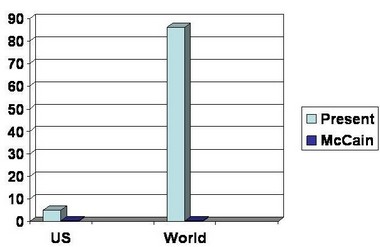
Given those facts, the implication that simply opening up more land to drilling is the solution becomes clearly erroneous. As it is, the oil companies have no incentive to significantly boost production, as they have no desire to see a large drop in prices. To them, the oil is much more valuable in the ground than out of it. This isn't a partisan opinion, it's just simple economics. They boost their price by limiting availability of their commodity.
Even working under the assumption that increased drilling will have the desired impact, what no one disagrees with is that its impact is about 10 years down the road, which obviously fails to address the current prices. Nonetheless, Bush and McCain gloss over that pesky reality on their way to promising they've found the solution to current levels, and most journalists are loathe to question just how they plan to eliminate the ten-year lead time from drilling to market.
Juan Cole reports that "if all the known offshore fields were drilled and panned out, the lower 48's oil production would be increased by 7%. That would be 300,000 barrels a day." This would affect gas prices by a few pennies if it could be sent to market immediately, but again that isn't feasible. Not to mention the Saudis just promised to increase production by 500,000 barrels a day and prices were not affected to any noticeable degree.
What is certainly true of the proposal to eliminate the ban on offshore drilling is that it indicates a continued dedication to allow the US energy markets to be held hostage by Middle East insecurity. By all accounts, renewed drilling will not even approach a level which would eliminate or even lower significantly US dependence on foreign oil, and would require the country to remain forever tied to a medieval, tyrannical regime and subject to regional insecurity for its oil supply.
Rather than taking the opportunity to find sources of energy which are more stable and more capable of eliminating reliance on unstable world markets, the Republicans choose to offer a solution which does nothing to quell that reliance and ignores the entire decade in between renewed drilling and production.
John McCain understood this for much of his tenure in the Senate, and it is only now, in his continuing effort to prove his Republican bona fides to the base that he has altered his tune. But what was true a year ago is true today. The oil companies have plenty of land on which to drill, but have chosen not to. Even after the ten-year lead time for new drilling to make it to market, its effect would be nothing more than a stalling tactic preventing the US from finding sources of energy independence.
Domestic drilling is hailed as serving that purpose, but no analysis of the possibilities of domestic production has suggested that as a feasible outcome, despite the wishful rhetoric.
Related:
Pure Speculation, June 12
Thursday, June 12, 2008
Pure Speculation
It is a long standing belief of mine--founded on nothing but mere observation--that the economic comprehension of Americans begins and ends with gas prices. A loose association to be sure, but it goes a long way toward paving the road for hours of discussion per day on the subject without ever addressing the core issues. Sure, cable news is rife with self-evident tips to save money on fuel--'drive less;' who knew?--and coinage of meaningless phrases like 'staycation,' but absolutely no examination of the root cause of the prices.
It is this environment which allows the fallacy that the prices are purely a reflection of supply and demand to be perpetuated by people like the Fed Chairman and oil executives. At this point, it is beyond all doubt that a healthy percentage of the price of a barrel of oil is based on speculation alone, based on artificial shortages created on paper in the futures market rather than physical shortages, and yet feeding the public a line that pretends gas prices are held to the same laws as widgets in a elementary economics textbook is enough to throw them off the scent. And given the current pathetic state of American media, they're not enthused about putting in any more effort than simply reporting the statements without qualifiers of any kind.
In order to establish any such simple relationship, however, it seems that one would need to be able to point to either a decrease in supply or an increase in demand that outpaces production capacity. Neither apply.
A quick toggle through the OPEC production levels over the past decade show that quarter 1 production in 2008 has been on pace, if not beyond that of the previous years. That leaves out any significant foreign production capacity issues, so we turn to home. Domestic production has been down slightly, true, but the Republican mantra of making more land available for drilling is simply well off the mark.
The cause celebre is ANWR, which is presented by the talking heads and on the Senate floor as the only available piece of land for new drilling. Even assuming that was the case, the EIA analysis of the likely production capabilities of the area doesn't point to a significant boost to domestic production or affect gas prices in any meaningful way.
With respect to the world oil price impact, projected ANWR oil production constitutes between 0.4 and 1.2 percent of total world oil consumption in 2030 [assuming leasing had gone forward in the 90s], based on the low and high resource cases, respectively. Consequently, ANWR oil production is not projected to have a large impact on world oil prices. Relative to the AEO2008 reference case, ANWR oil production is projected to have its largest oil price reduction impacts as follows: a reduction in low-sulfur, light (LSL) crude oil prices of $0.41 per barrel (2006 dollars) in 2026 in the low oil resource case, $0.75 per barrel in 2025 in the mean oil resource case, and $1.44 per barrel in 2027 in the high oil resource case. Assuming that world oil markets continue to work as they do today, the Organization of Petroleum Exporting Countries (OPEC) could neutralize any potential price impact of ANWR oil production by reducing its oil exports by an equal amount.
But, of course, ANWR isn't the only land in the US available for drilling, as this Committee on Natural Resources report illustrates quite clearly.
Between 1999 and 2007, the number of drilling permits issued for development of public lands increased by more than 361%, yet gasoline prices have also risen dramatically contradicting the argument that more drilling means lower gasoline prices. There is simply no correlation between the two.
Even if increased domestic drilling activity could affect the price of gasoline, there is yet no justification to open additional federal lands because oil and gas companies have shown that they cannot keep pace with the rate of drilling permits that the federal government is handing out.
In the last four years, the Bureau of Land Management has issued 28,776 permits to drill on public land; yet, in that same time, 18,954 wells were actually drilled. That means that companies have stockpiled nearly 10,000 extra permits to drill that they are not using to increase domestic production.
Hence, ANWR has been held up, not as the last great hope for domestic drilling, but as a 'want-what-I-can't-have' prospect that ignores the availability of immense amounts of other land on which to drill. Oil companies are only drilling on 27% of the federal lands leased to them and 24% of the offshore acres, leaving the companies with 68 million acres of leased acreage on which they are not producing oil or gas. From this it becomes clear that the problem is not the availability of land on which to drill, but the ability of the oil companies to produce on the land that they've already leased.
As it stands, there's even plenty more land for lease to oil companies in Alaska's Arctic region, 91 million acres to be precise, of which only 11.8 have been leased. The National Petroleum Reserve-Alaska also presents 22 million available acres, of which 3 million have been leased. Seemingly, focus on a small area of less than 20 acres has prevented the usage of several times that many in the same region. To hold up ANWR as the last possibility in domestic production is fallacious and disingenuous.
As for demand in the US, the first quarter saw lower demand from the same period a year ago.
All this leads to speculation as the root cause of the steep increase in oil prices, not some simplistic supply-and-demand relationship which doesn't fit reality. A 2006 Senate report indicated that as much as 60% of the price of a barrel of crude was pure speculation, due to unregulated commodities trading made possible by the Enron Loophole slipped onto the end of an 11,000-page appropriations bill by Phil Gramm, among others.
Commodities trading, now free of the watchful eye of the CFTC, can lead to unfettered market manipulation and the creation of paper shortages. In other words, opaque trading practices make it appear as if there is a supply issue when in fact there is none.
The 2000 deregulation is more than a simple poor policy choice, it led directly and quickly to market manipulation, yet has not been altered.
In 2001, [sic] certain Wall Street executives [used] the media to sell the public on stocks in order to bid up the price – so their firm could divest of its shares without taking a beating. Meanwhile, other trusted advisers pushed stocks that were fundamentally worthless, because their affiliated banks had large loan agreements with those companies.
The year before Enron had been caught manipulating the California energy market, even forcing rolling blackouts across the northern part of their state apparently just for effect – to support their claim that there just wasn’t enough electricity to go around. Again, we now know that claim was untrue. It was Enron shutting down certain power generation plants, while placing bets on their unregulated energy futures market. The net cost to California consumers was almost $8 billion.
It didn’t end there. Amaranth Advisors, a hedge fund, literally was cornering the market on natural gas futures, to make it appear that there was a shortage of natural gas, when the Commodities Futures Trading Commission told Amaranth to liquidate its position on the NYMEX because its bidding had already moved natural gas prices far beyond the reasonable limits of supply and demand. Now, remember this name: ICE, short for Intercontinental Exchange – the "dark futures lookalike market."
Once the CFTC told it to back off its natural gas futures contracts, Amaranth simply shifted gears, got out of the NYMEX, placed its massive bets outside of government regulation in ICE and managed to drive natural gas futures to $8.50 per MBtu.
As the Senate investigation into the manipulation of the energy markets showed, "Amaranth – the day before they failed, natural gas was about $8.50; the day after it failed, it went to $4.46 MBtu." That’s right, one major hedge fund managed to double the price of natural gas simply by loading up on futures contracts; when the government told them their bets were unwarranted, they simply moved their monies to a futures exchange that was unregulated. Only when Amaranth failed did natural gas prices fall back to what was considered normal for supply and demand.
Sadly, like oil today, when this was happening we were being told that natural gas supplies were tight worldwide. That statement simply wasn’t true.
Yet, for the mountain of evidence available just since the deregulation of the markets, the same false premise of a supply/demand market price is allowed to be perpetuated without question. Nothing could be more evident based on every available metric and on recent history of energy commodities, be it electricity, natural gas, or oil.
There is no shortage of oil. The only thing lacking is honesty.
Sphere: Related Content
Saturday, April 26, 2008
Do What Now?
Sometimes you can't help but laugh:
As negotiations on a farm bill have stumbled, Bush has asked the House and Senate to extend the law for a year or longer. He says the new legislation is too expensive and would not do enough to cut subsidy payments to wealthy farmers in a time of record crop prices.
So, let me get this straight. Bush doesn't like the legislation because it subsidizes wealthy members of a large, profitable industry in a time of record prices for the products of said industry.
It seems that same logic could apply to another industry in those exact terms. Care to cut those subsidies, Mr. Bush? Didn't think so.
Sphere: Related Content


