I think this subject is pretty well covered by the usual suspects, so I'll keep it brief. I only have an interest in the NFL v Limbaugh case because I'm a Rams fan in Saint Louis. Though, witnessing what I have for the first third of the season, I would accept anyone as an owner if they promised not to keep the team in town.
Anyway, Rush, the firestorm is not about your conservative politics. You need only look across town to the Cardinals for proof of that. Bill DeWitt, owner of the team, was one of the larger donors to President Bush in the 2000 and 2004 elections. No one cared. I would assume (I'm not sure if such numbers are available) that at least 80 percent of the owners of professional sports teams are conservative or donate to Republicans more than Democrats. Again, nobody cares.
No one would oppose your bid for the team because you favor free-market policies. No, Rush, they opposed your bid because it was to buy a franchise predominantly staffed by black employees while you, yourself, a provably a racist.
And, please, cut the PC police bullshit. When your response to a fight among teenagers is to call for re-segregation, you're a racist. When you suggest that the sport which your potential team plays is like watching the Cryps and Bloods go at it, you're a racist. Reading your view into de Tocqueville or Adam Smith wouldn't have disqualified you, and you know it.
Anyway, aren't the Rams awful enough without forcing them to compete with a team that looks like it came out of the 30s?
Thursday, October 15, 2009
Sports and Politics


Saturday, October 10, 2009
Obama and Nobel: Absurdity on Parade
Sometimes life's absurdities become so blatant, so consuming, that one cannot hellp but question the sanity of the world we live in. One cannot sanely sympathize with poor white people that protest against a lone black man because they envision some sort of holocaust against their meager existence while in fact this same man is tirelessly working to promote the fortune and power of the same white, Protestant men who've always held the same. How does one begin to argue with a man or woman who has been convinced to fight, sometimes violently, to promote someone else's interests to the detriment of their own?
How does one begin to argue with a nation of immigrants who believe to the core of their souls that this wave of immigrants are not lured by higher pay than they can find in their own country (thanks in part to US policies) but rather by a genocidal desire to murder their children? How does one convince a man like Rush Limbaugh or his drones that teenagers fight over stupid things like seats on a bus and that such an occurrence is not an indicator of a large-scale conspiracy on the part of all black people to exterminate the white race, as if whites were somehow on the precipice of extinction?
How, then, are we to respond to the news that a man responsible for widespread death in three countries, bellicose threats to another, and demonstrable loyalty to the position that you're either with the United States or you're dead receiving a prize for the propagation of Peace?
The President:
Let me be clear: I do not view it as a recognition of my own accomplishments, but rather as an affirmation of American leadership on behalf of aspirations held by people in all nations.
Presumably, "all nations" is typical US code for those nations that agree with our foreign policy. One cannot believe that every Afghani who's had his home destroyed by American soldiers or paid mercenaries cheers "American leadership" as he watches the smoldering rubble of his former life.
The Orwellian construct, "War is Peace," is prescient here. Obama has yet to deviate from the neoconservative delusion that the only way to bring peace through the world is through endless war. Here, there is no alternative to the Bush worldview; a worldview which allows a man to stand above the fray, safely removed from danger, look over the smoldering of several countries and pride themselves on how much peace their weapons have wrought.
Part of the explanation of the prize was also Obama's supposed commitment to ridding the world of nuclear weapons. Of course, nowhere in that idealistic endeavor is the world's largest stockpile of nuclear weapons mentioned. That would just be insane. Ignorance is Knowledge.
All this lends credence to what C Wright Mills called "crackpot realism."
From the essay "On Knowledge and Power:"
It is not the barbarous irrationality of uncouth, dour Senators that is the American danger; it is the respected judgments of Secretaries of State, the earnest platitudes of Presidents...that is the main danger. For these men have replaced mind by the platitude, and the dogmas by which they are legitimated are so widely accepted that no counter-balance of mind prevails against them. Such men as these are crackpot realists, who, in the name of realism have constructed a paranoid reality all their own and in the name of practicality have projected a utopian image...
Or from The Causes of World War Three:
In crackpot realism, a high-flying moral rhetoric is joined with an opportunist crawling among a great scatter of unfocused fears and demands. In fact, the main content of “politics” is now a struggle among men equally expert in practical next steps—which, in summary, make up the thrust toward war—and in great, round, hortatory principles. (p. 86)
. . . The expectation of war solves many problems of the crackpot realists; it also confronts them with many new problems. Yet these, the problems of war, often seem easier to handle. They are out in the open: to produce more, to plan how to kill more of the enemy, to move materials thousands of miles. . . . So instead of the unknown fear, the anxiety without end, some men of the higher circles prefer the simplification of known catastrophe. (p. 87)
. . . They know of no solutions to the paradoxes of the Middle East and Europe, the Far East and Africa except the landing of Marines. Being baffled, and also being very tired of being baffled, they have come to believe that there is no way out—except war—which would remove all the bewildering paradoxes of their tedious and now misguided attempts to construct peace. In place of these paradoxes they prefer the bright, clear problems of war—as they used to be. For they still believe that “winning” means something, although they never tell us what. (p. 88)
. . . Some men want war for sordid, others for idealistic, reasons; some for personal gain, others for impersonal principle. But most of those who consciously want war and accept it, and so help to create its “inevitability,” want it in order to shift the locus of their problems. (p. 88)
So, these politicians create their own reality, again in the Orwellian fashion, in which all anxieties, all uncertainties, are eliminated. From whole cloth, they create a world where victory and defeat fall along clearly-defined lines (though they are never able to express those lines to the public). In their world, enemies and friends are clearly defined, and the status of good and evil coincide perfectly. Circular logic dictates that friends are good, enemies are evil. That one defines the other does not seem to trouble their minds, from which they have systematically removed all seeds of doubt or attempts at objective definition.
Having created this reality, these politicians then foist it upon the world. This fabricated worldview becomes truth, rather than the reverse, and the world must subscribe to the reality as the politicians fight vociferously to defend their creation.
Once created, this worldview cannot be questioned. All positions must then flow forth from it. One must begin with the assumption that bombing villages breeds peace. One must subscribe to the notion that the countries with the largest nuclear arsenals are the natural leaders in the cause of reducing such arsenals (in those countries that don't have them). One must accept without question that no matter how poorly a war has been waged for nearly a decade, success (indefinable though it is) is just around the corner, if only a few thousand more soldiers can be brought ashore.
The most important feature of crackpot realism then, is the inability of observers to engage in any discussion which does not begin with the assumption of all that the crackpots have constructed. All discussion of foreign policy must begin with their fabricated premises, which ensures that such a debate cannot possibly progress. Much of the country, and apparently the world, fails to see this.
As long as discussion is constrained to the limits that the rulers set, "peace" is a fantasy. Indeed, mere mention of the word presents the speaker to the word as a wild-eyed naif unfit for public consumption. There is no reason for this to be. There is no reason that discussion should be constrained by bounds set by those who stand to profit most from its limitation. There is no reason that awards for peace should be awarded to a man who's only qualifications seem to be that he is the most eloquent of the ambassadors for the world of the crackpot realists.
When debate is artificially constrained, it ceases to be debate at all. It has become absolution of a vile worldview.
Sphere: Related Content
Wednesday, October 7, 2009
Congress Demonstrates its Fiscal Skepticism
Er, title changed to reflect the fact that I'm not an idiot re: possessive v. contraction
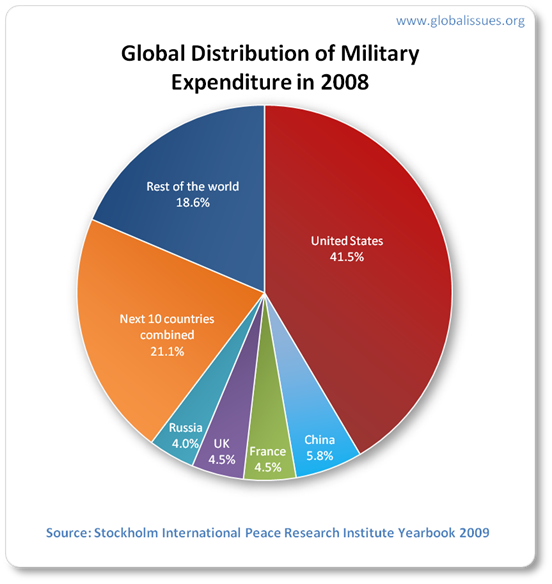
So, that crusader for peace and hope, Barack Obama, has once again demonstrated his commitment to prolonging the Bush presidency. On Tuesday, the Senate approved his first defense budget, with the stated price tag of $626 billion, the largest ever. That's greater than the GDP of all but 17 countries using the IMF numbers from 2008. And again, this was significantly higher than the largest budget requested by Bush, putting perhaps the final nail in the coffin of the fantastical belief that Obama will lead the country down a different path in foreign policy.
I say "stated" because history shows that the Defense Department is never held to the number. If the budget runs over, so be it. Also, as Tom Engelhardt notes, "various military expenses like the upkeep of our nuclear arsenal aren't even in that budget."
The budget itself is no surprise, as any suggestions that the US will ever pare down its military expenditures are grounds for forced commitment and life in a padded cell. The grating part is that for months Republicans and Democrats alike have been parading around feigning fiscal responsibility in the health care debate, rushing to declare that $850 billion over 10 years signifies the height of recklessness. Yet here we see the Senate pass a bill 93-7 which promises to exceed that in less than a year and half. Bipartisanism is alive and well, indeed.
But it’s more than simply the obvious lack of logical continuity and mathematical literacy here. It’s the laughable claim that these Congressmen oppose any sort of health care reform on the grounds that it would put the government into a controlling position over the free market. But consider where this money goes. It is nothing but a vast diversion of public money (presumably the same money the tea-baggers would like back) to private companies.
The money will go, as always, to the same companies lusting for the free market in no-bid, cost-plus contracts. It will go toward creating artificial overseas markets for those same companies. It will provide those companies with a consumer (us) with no arena for recourse, no ability to express displeasure with capital flight; Or, not one indicator of the free market these businesses and their compatriots in Congress claim their un-dying affection for. Artificial markets. No free choice on the part of the consumer. Nothing which would signify free market principles.
Of course, the claim will be made that “defense” is not something to be debated. Unlike health care, “defense” is not an arena where these vermin who vacillate over every last dollar of a health care bill can enter with similar skepticism. The President says “I want this much (for now),” and Congress says, “How fast can I funnel that to you?”
And of course, using the money as the United States is wont to do will always create a higher demand for the next year’s budget. We need the money for defense because people hate us, we use the money to exacerbate those feelings, therefore we will need more next year to combat the bile we’re milked from the world in this one. All the while, we pretend that Afghanis and Iraqis will forget that they are without electricity, food, or basic security from bodily harm. They will forget the death squads, forget the corrupt governments, forget the Predator raids on weddings. They will forget, and then they’ll love us and our freedoms.
Until then, dying Americans will just have to wait while Congress spends as much in less than 18 months—without batting an eye—as they refuse to consider spending over the course of a decade for their own citizens.
Related Posts:
Mental Recession or Just Mental? July 15, 2008
Surge II: Afghanistan July 15, 2008
Why Are We Stupid?
I don't do the day-to-day minutiae of political theatrics, but somebody was going into a long spiel about Obama and TelePrompters to me the other day. My mind understandably wandered between "Who could possibly care this much about something so meaningless?" and "Somebody feeds him every argument, so this thought must have manifested itself among others." And lo, a Google search.
Anyway, nothing really to say. What can you say? Just this:
Argument. Over.
Probably not.





